


Medical Spanish
Beginner Medical Spanish Vocabulary by Body System
Do not try to memorize an anatomy textbook in Spanish. For beginner medical Spanish vocabulary, choose the two body systems your role encounters most often, learn 8–12 plain-language terms for each, and practice those words inside short location and symptom questions.

Which body-system vocabulary should you learn first?
The right starting point depends on the conversations you actually have. A front desk team may need only a few location words before connecting the patient with clinical staff. A medical assistant may hear more symptom and body-part language. A learner preparing for dental care, physical therapy, or urgent care should build a narrower list around that setting.
| If you often help with… | Start with… | Practice alongside… |
|---|---|---|
| General intake or urgent complaints | Body location, musculoskeletal, digestive, respiratory | Spanish intake questions |
| Pain or mobility | Musculoskeletal and nervous system | Spanish pain-scale questions |
| Breathing or circulation | Respiratory and cardiovascular | Symptom and chief-complaint questions |
| Medication or follow-up | Only the system relevant to the patient’s instructions | Medication instruction phrases |
Start with location words that work across systems
Before studying organs, learn words that help a patient indicate where something hurts or feels different. These are reusable across many settings.
| English | Spanish | Useful pattern |
|---|---|---|
| head / neck | la cabeza / el cuello | ¿Le duele la cabeza? — Does your head hurt? |
| chest / back | el pecho / la espalda | ¿Le duele el pecho? — Does your chest hurt? |
| abdomen | el abdomen | ¿Le duele el abdomen? — Does your abdomen hurt? |
| right / left side | el lado derecho / el lado izquierdo | ¿De qué lado? — On which side? |
| upper / lower part | la parte superior / la parte inferior | ¿Aquí, en la parte inferior? — Here, in the lower part? |
| inside / outside | adentro / afuera | ¿Lo siente adentro? — Do you feel it inside? |
Safer beginner pattern: point only when appropriate, name the location, and confirm what you heard. Do not turn a vocabulary prompt into a leading diagnostic question. If the answer becomes detailed, uncertain, or clinically important, pause and obtain qualified language support.
Musculoskeletal vocabulary: bones, joints, and muscles
This is a practical first group because people commonly describe pain, stiffness, swelling, and movement using these locations.
| English | Spanish | Practice phrase |
|---|---|---|
| bone / muscle | el hueso / el músculo | ¿Es dolor de músculo? — Is it muscle pain? |
| joint | la articulación | ¿Le duele la articulación? — Does the joint hurt? |
| shoulder / elbow | el hombro / el codo | Mueva el codo, por favor. — Move your elbow, please. |
| wrist / hand | la muñeca / la mano | ¿Puede mover la muñeca? — Can you move your wrist? |
| hip / knee | la cadera / la rodilla | ¿Cuál rodilla le duele? — Which knee hurts? |
| ankle / foot | el tobillo / el pie | ¿Puede apoyar el pie? — Can you put weight on the foot? |
Digestive vocabulary: abdomen and digestion
Use plain patient-facing terms first. Specialized terminology can wait until your role and verified training require it.
| English | Spanish | Practice phrase |
|---|---|---|
| stomach | el estómago | ¿Le duele el estómago? — Does your stomach hurt? |
| liver | el hígado | el hígado — the liver |
| intestine | el intestino | el intestino delgado — the small intestine |
| nausea / vomiting | las náuseas / los vómitos | ¿Tiene náuseas? — Do you have nausea? |
| diarrhea / constipation | la diarrea / el estreñimiento | ¿Tiene diarrea? — Do you have diarrhea? |
| appetite | el apetito | ¿Ha cambiado su apetito? — Has your appetite changed? |
Respiratory vocabulary: lungs and breathing
| English | Spanish | Practice phrase |
|---|---|---|
| lungs | los pulmones | los pulmones — the lungs |
| throat | la garganta | ¿Le duele la garganta? — Does your throat hurt? |
| breathing | la respiración | ¿Le cuesta respirar? — Is it hard to breathe? |
| cough | la tos | ¿Tiene tos? — Do you have a cough? |
| shortness of breath | la falta de aire | ¿Tiene falta de aire? — Are you short of breath? |
| inhale / exhale | inhalar / exhalar | Inhale y exhale lentamente. — Inhale and exhale slowly. |
Breathing complaints can be urgent. A memorized phrase is not a substitute for your emergency protocol or qualified interpretation.
Cardiovascular vocabulary: heart and circulation
| English | Spanish | Practice phrase |
|---|---|---|
| heart | el corazón | el corazón — the heart |
| blood | la sangre | una muestra de sangre — a blood sample |
| vein / artery | la vena / la arteria | la vena — the vein |
| pulse | el pulso | Voy a tomarle el pulso. — I am going to take your pulse. |
| blood pressure | la presión arterial | Voy a medirle la presión arterial. — I am going to measure your blood pressure. |
| swelling | la hinchazón | ¿Cuándo empezó la hinchazón? — When did the swelling begin? |
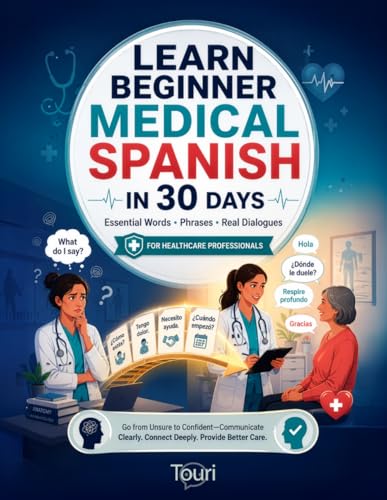
Learn Beginner Medical Spanish in 30 Days
Use the book as a structured practice companion: choose one role-relevant phrase set, say it aloud, then review it again the next day. It supports language study and does not confer certification or replace interpreter training.
Nervous-system and urinary vocabulary
These two smaller sets are useful when they match your role. Keep them separate until each set is easy to recall.
| System | English | Spanish |
|---|---|---|
| Nervous | brain / nerve | el cerebro / el nervio |
| Nervous | dizziness / numbness | el mareo / el entumecimiento |
| Nervous | tingling / weakness | el hormigueo / la debilidad |
| Urinary | kidney / bladder | el riñón / la vejiga |
| Urinary | urine / urinate | la orina / orinar |
| Urinary | urine sample | una muestra de orina |
Example prompts include ¿Siente mareo? (Do you feel dizzy?) and Necesitamos una muestra de orina (We need a urine sample). Whether you should use those prompts with a patient depends on your role, protocol, and language-access policy.
Three question patterns that make vocabulary usable
- Location: ¿Dónde le duele? — Where does it hurt?
- Timing: ¿Cuándo empezó? — When did it begin?
- Confirmation: ¿Dijo que le duele la rodilla derecha? — Did you say your right knee hurts?
Practice the pattern with one vocabulary set at a time. For example, replace la rodilla with el hombro, el tobillo, or la espalda. This builds active recall without encouraging you to improvise complex clinical language.
A seven-day beginner study plan
| Day | Focus | Recall check |
|---|---|---|
| 1 | Choose two relevant body systems; learn eight words from the first. | Name them without looking. |
| 2 | Add the location question and two confirmation phrases. | Say each prompt aloud three times. |
| 3 | Learn eight words from the second system. | Sort mixed flashcards by system. |
| 4 | Practice one short, non-diagnostic roleplay. | Stop when the response exceeds your phrase set. |
| 5 | Review difficult words and accents. | Write the Spanish from the English cue. |
| 6 | Pair vocabulary with medical Spanish audio practice. | Repeat after the model, then recall without audio. |
| 7 | Run a two-minute mixed review. | Keep only words relevant to your role. |
Evidence and terminology notes
The system groupings and Spanish anatomy terminology were checked against MedlinePlus en español’s anatomy resources and its body-parts and systems index, both produced by the U.S. National Library of Medicine. Terminology can vary by country and workplace, so verify specialized wording against your organization’s approved materials.
The interpreter boundary follows the U.S. Department of Health and Human Services Office for Civil Rights guidance on language assistance for people with limited English proficiency. This article is a language-learning resource, not clinical guidance, interpreter training, or proof of professional proficiency.
FAQ
Can I use these phrases instead of a medical interpreter?
No. These phrases are for language practice and limited routine support. Follow your organization’s language-access process and use a qualified medical interpreter for consent, diagnosis, treatment, medication counseling, discharge, emergencies, or other safety-critical communication.
How many medical Spanish terms should a beginner learn at once?
Start with 8–12 terms from one role-relevant body system. Add a second set only after you can recall the first group inside short location and confirmation questions.
Should I learn technical anatomy terms or patient-friendly words first?
Most beginners should learn plain patient-facing words first, then add specialized terminology required by their role and verified training. Terminology study does not replace clinical or interpreter qualifications.