


Medical Spanish
Spanish Questions for Symptoms and Chief Complaint
For symptoms and chief complaint in Spanish, start with a short intake sequence: what brought the patient in, where the problem is, when it started, how strong it feels, and whether anything makes it worse. This guide gives healthcare workers a safe phrase bank for routine communication and shows when to move from basic Spanish support to a qualified interpreter.

What this page helps you decide
- If you need a first phrase set, learn chief complaint, location, timing, severity, and interpreter-boundary questions before long vocabulary lists.
- If the patient gives a complex answer, do not guess from partial Spanish. Pause and use qualified language support.
- If you are studying before a shift, practice one short sequence you can repeat consistently instead of memorizing scattered words.
- If you want a broader routine, connect this page to the Touri medical Spanish study plan and book practice path.
Core chief complaint questions
Start with short, predictable questions. The goal is not to conduct a full clinical interview in a language you are still learning. The goal is to recognize common patient responses, avoid guessing, and know when the conversation needs interpreter support.
| English | Spanish | Use it for |
|---|---|---|
| What brings you in today? | Que le trae hoy? | Opening chief complaint question. |
| What is the main problem? | Cual es el problema principal? | Clarifying the first concern. |
| Where does it hurt? | Donde le duele? | Pain location. |
| When did it start? | Cuando empezo? | Timing and onset. |
| Is it getting worse? | Esta empeorando? | Change over time. |
| How strong is the pain from zero to ten? | Que tan fuerte es el dolor, de cero a diez? | Pain scale practice. |
| Does anything make it better or worse? | Algo lo mejora o lo empeora? | Basic aggravating or relieving factors. |
| Do you have fever, nausea, or shortness of breath? | Tiene fiebre, nausea o falta de aire? | Simple symptom screening. |
| Please say that again slowly. | Digalo otra vez despacio, por favor. | Clarification without pretending. |
| We will call an interpreter. | Vamos a llamar a un interprete. | Escalating to qualified language support. |
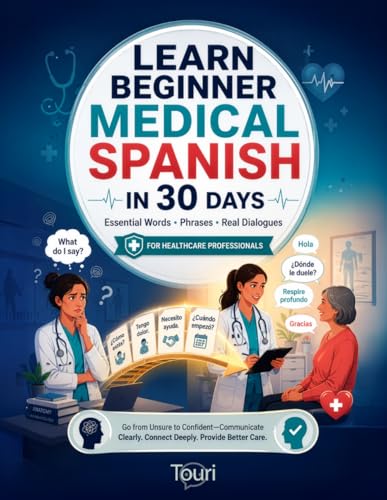
Learn Beginner Medical Spanish in 30 Days
Use this as the print companion for repeated medical Spanish practice. Start with intake and symptom questions, then rehearse the same phrases aloud until they are easy to recall.
Use this order during practice
A repeatable order matters because real intake is a sequence, not a vocabulary quiz. Practice the same order until it feels automatic, then add role-specific questions for your clinic or unit.
| Step | Question type | Safe learner goal |
|---|---|---|
| 1 | Chief complaint | Identify the reason for the visit in simple terms. |
| 2 | Location | Connect symptoms to body areas without guessing. |
| 3 | Timing | Recognize today, yesterday, days, weeks, sudden, and gradual. |
| 4 | Severity | Ask a simple pain scale and repeat the number back. |
| 5 | Safety boundary | Call an interpreter when the answer becomes complex or high risk. |
Words you will hear in symptom answers
These words are useful because they help you recognize the shape of the patient’s answer. Recognition is not the same as full comprehension. If the answer is unclear, serious, or clinically important, use interpreter support.
| Spanish | English | Listen for |
|---|---|---|
| dolor | pain | Location and severity. |
| mareo | dizziness | Timing, falls, and associated symptoms. |
| fiebre | fever | Duration and temperature history. |
| tos | cough | Duration, breathing, and fever. |
| nausea | nausea | Onset and medication context. |
| falta de aire | shortness of breath | Urgency and immediate escalation. |
| desde ayer | since yesterday | Symptom timing. |
| de repente | suddenly | Possible urgency; do not rely on partial understanding. |
Short intake mini-dialogue
Use mini-dialogues to practice sequencing. Keep the exchange short enough to say aloud without reading every line.
| Speaker | Spanish | English |
|---|---|---|
| Staff | Hola, me llamo Ana. Que le trae hoy? | Hello, my name is Ana. What brings you in today? |
| Patient | Me duele el pecho. | My chest hurts. |
| Staff | Cuando empezo? | When did it start? |
| Patient | Hace una hora. | One hour ago. |
| Staff | Vamos a llamar a un interprete para ayudarle. | We are going to call an interpreter to help you. |
Notice the boundary in the final line. A learner can ask a few routine questions, but chest pain, breathing problems, neurological symptoms, severe pain, medication risk, or complex history should move quickly to qualified language support.
A 20-minute practice block
| Minute | Action | Goal |
|---|---|---|
| 0-4 | Read the core question table once for meaning. | Understand the intake sequence. |
| 4-9 | Say each Spanish question aloud three times. | Build spoken recall. |
| 9-13 | Cover the Spanish and produce it from the English. | Move from recognition to recall. |
| 13-17 | Roleplay two short chief-complaint exchanges. | Practice sequence, not isolated words. |
| 17-20 | Repeat the interpreter phrase and note unclear responses. | Make the safety boundary automatic. |
Evidence and source notes
This refresh was prioritized because Touri already has GSC visibility around Spanish and medical Spanish product pages, while the medical Spanish article cluster is an important bridge from informational searches to books and future audio practice. The current local GSC export covers January 1, 2025 through May 27, 2026 and shows exposure for queries including spanish for medicine and spanish in 100 days on Touri medical Spanish book URLs.
For external standards, the safe operating boundary is intentionally conservative: language practice can help with rapport and routine workflow, but qualified interpreter use remains the appropriate path for care decisions, legal documentation, complex instructions, and high-risk conversations.
Where to go next
After this chief complaint sequence, choose the next page based on the learner’s role or the encounter type.
- Spanish Intake Questions for Clinics and Hospitals for a broader intake workflow.
- Spanish Pain Scale Questions for Healthcare Professionals for pain-specific practice.
- Medical Spanish for Healthcare Professionals for the cluster overview.
- When Healthcare Workers Should Use an Interpreter for boundaries and escalation.
Common mistakes to avoid
- Using a memorized question when you cannot understand the answer.
- Skipping the interpreter phrase because it feels less like language practice.
- Learning symptom nouns without practicing timing, severity, and clarification questions.
- Trying to translate a full medical history instead of using qualified language support.
- Assuming phrase study creates certification, interpreter competence, or clinical authority.
FAQ
What Spanish question should I learn first for chief complaint?
Start with Que le trae hoy?, which means “What brings you in today?” Then add location, timing, severity, clarification, and interpreter-support phrases.
Can I use these symptom questions instead of a medical interpreter?
No. These questions are for routine language practice and basic communication support. Use a qualified medical interpreter whenever accuracy, consent, diagnosis, treatment, medication risk, discharge instructions, or patient safety is involved.
How should I practice Spanish symptom questions?
Practice a short sequence aloud for 10 to 20 minutes: chief complaint, location, timing, pain scale, clarification, and interpreter escalation. Repeating the sequence is more useful than memorizing disconnected vocabulary.