

Spanish Reading Practice
Beginner Spanish Reading Comprehension Questions to Ask After Every Story
After a beginner Spanish story, ask questions in a useful order: first identify who, where, and what happened; then put events in sequence; finally explain a character’s reason and retell the story. This shows whether the text is at the right level and turns reading into active Spanish practice.

Which questions should a beginner ask?
The best questions move from information stated directly in the story to ideas the reader must connect. Start with the first row below and stop when the questions become guesswork. That stopping point helps you choose the next reading level.
| Question type | Spanish prompt | What it checks |
|---|---|---|
| Basic fact | ¿Quién es el personaje principal? | Can you find information stated directly? |
| Setting | ¿Dónde ocurre la historia? | Can you identify where the action happens? |
| Sequence | ¿Qué pasa primero, después y al final? | Can you order the main events? |
| Reason | ¿Por qué toma esa decisión? | Can you connect an action to a reason? |
| Context | ¿Qué significa esta palabra en la oración? | Can you infer meaning without translating everything? |
| Retell | ¿Puedes resumir la historia en tres frases? | Can you recall the beginning, change, and outcome? |
A beginner does not need a long written answer every time. A name, location, numbered event list, or three short sentences can provide enough evidence of understanding.
A 10-question checklist for any short Spanish story
- ¿Quién es el personaje principal? Who is the main character?
- ¿Dónde está al principio? Where is the character at the beginning?
- ¿Qué quiere o necesita? What does the character want or need?
- ¿Cuál es el problema? What is the problem?
- ¿Qué pasa primero? What happens first?
- ¿Qué cambia después? What changes next?
- ¿Cómo responde el personaje? How does the character respond?
- ¿Cómo termina la historia? How does the story end?
- ¿Qué tres palabras o frases puedes entender por el contexto? Which three words or phrases can you understand from context?
- ¿Cómo resumirías la historia en tres frases? How would you summarize the story in three sentences?
Use all ten questions for a weekly check. For everyday reading, choose five: questions 1, 4, 6, 9, and 10 give a balanced check without turning the story into a test.
How to answer when your Spanish is still limited
Comprehension can be ahead of speaking or writing. Use an answer ladder so limited output does not hide what you understood:
- Point to the evidence. Find and underline the sentence that answers the question.
- Answer with one word or a short phrase. For ¿Dónde ocurre?, “en una cafetería” is enough.
- Reuse the question frame. Change ¿Qué quiere Ana? into Ana quiere un café.
- Add one connector. Use porque, pero, después, or por eso to connect ideas.
Answering in English on the first pass is acceptable when the goal is to check meaning. On the second pass, return to the Spanish text and build the shortest accurate Spanish answer you can.
Worked example: a four-sentence beginner story
Lucía va al mercado porque necesita tomates. Busca en su bolsa, pero no encuentra su cartera. El vendedor guarda los tomates mientras Lucía vuelve a casa. Una hora después, Lucía regresa y compra los tomates.
Meaning: Lucía goes to the market because she needs tomatoes. She looks in her bag but cannot find her wallet. The seller holds the tomatoes while Lucía returns home. An hour later, she comes back and buys them.
| Question | Short Spanish answer | Evidence to notice |
|---|---|---|
| ¿Adónde va Lucía? | Va al mercado. | The first sentence states the place. |
| ¿Por qué no compra los tomates? | Porque no encuentra su cartera. | Pero signals the problem. |
| ¿Qué hace el vendedor? | Guarda los tomates. | The verb describes how he helps. |
| ¿Qué pasa al final? | Lucía regresa y compra los tomates. | Una hora después introduces the outcome. |
For a retell, a beginner could say: Lucía necesita tomates. No tiene su cartera y vuelve a casa. Después, regresa al mercado y compra los tomates. It is simpler than the original, but it preserves the problem, action, and result.
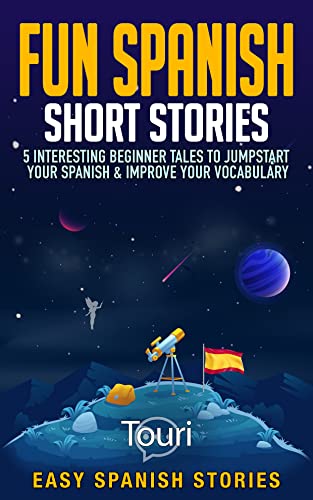
Fun Spanish Short Stories
Want a collection you can use with this question checklist? Preview the Touri short-story book, then sample the language and choose it only if you can follow the main event without constant translation.
How to tell whether the story is at the right level
| Your result after one careful read | What to do next |
|---|---|
| You answer the fact and sequence questions but need the text for the retell. | Keep the story. Reread once and try a shorter retell. |
| You understand the main event but miss several details. | Read a smaller section and preview only the essential vocabulary. |
| You cannot identify the character’s goal or the central problem. | Choose an easier story or one with vocabulary support. |
| You answer every question immediately and retell with ease. | Move to a longer story or add inference and opinion questions. |
The goal is not perfect recall. A productive beginner text leaves a few gaps but still lets you explain the main event. If dictionary checks interrupt nearly every sentence, the text is too demanding for comprehension practice right now.
A repeatable 20-minute reading session
- Preview for 2 minutes: read the title, inspect any image, and predict the setting.
- Read for 6 minutes: finish a short section without stopping for every unknown word.
- Answer for 5 minutes: complete one fact, sequence, reason, context, and retell question.
- Check for 4 minutes: return to the exact sentences that support or correct your answers.
- Retell for 3 minutes: say three sentences using primero, después, and al final.
If twenty minutes feels long, split it across two days: read and answer basic questions on day one; check the text and retell on day two. The Spanish reading practice routine offers more ways to adjust the timing.
Questions that improve vocabulary without making a giant list
Instead of copying every unfamiliar word, ask three targeted questions:
- Which word blocks the main event? Look up only a word that prevents you from understanding what changed.
- Which phrase could I reuse? Save a chunk such as no encuentra… or una hora después, not only an isolated noun.
- Which clue helped me infer meaning? Note a contrast word, action, familiar root, or later sentence that clarified it.
Keep three to five useful items per story. For a simple system, see how to build a Spanish vocabulary list from stories.
Common comprehension mistakes
- Asking only opinion questions: “Did you like it?” does not show whether the events were understood.
- Translating before reading for meaning: first identify the people, goal, problem, and outcome.
- Requiring long Spanish answers: keep the language demand small enough to measure comprehension.
- Checking answers from memory alone: return to the sentence that supports each response.
- Changing stories too quickly: a second reading is where sequence, phrasing, and details often become clearer.
Choose your next Spanish reading path
If you need easier input, start with beginner stories with vocabulary support. If the checklist feels comfortable, compare stories with and without English translation and begin answering “why” questions before checking the translation. To compare Touri’s story, dialogue, and level options, use the Spanish language book hub.
FAQ
What questions should I ask after reading a Spanish story?
Ask who, where, what the character wants, what problem occurs, what happens first and next, why a decision is made, and how the story ends. Finish with a three-sentence retell.
Should a beginner answer comprehension questions in Spanish?
Use English or point to the evidence when necessary on the first pass. Then reuse words from the question and story to give the shortest accurate Spanish answer you can.
How many questions should I answer after each story?
Five balanced questions are enough for a normal session: one fact, one sequence, one reason, one context clue, and one retell. Use the full ten-question checklist for an occasional deeper review.