

Medical Spanish
Spanish for Pharmacy and Prescription Pickups
For pharmacy and prescription pickup Spanish, start with the handoff questions that come up before a medication leaves the counter: name, date of birth, allergies, refills, dosage timing, side effects, and whether the patient needs the pharmacist. This guide gives healthcare workers and pharmacy staff a practical phrase set for routine support, plus clear boundaries for moments that need a qualified interpreter or licensed clinician.

Who this guide is for
This guide is for healthcare workers, pharmacy technicians, medical assistants, students, clinic staff, and language learners who want Spanish for pharmacy and prescription pickups to feel usable in real patient-facing moments. It is written for practical study, not for replacing professional interpreters, pharmacists, prescribers, or clinical judgment.
The learner decision is simple: if you work around prescriptions, which Spanish phrases should you practice first so routine pickup and refill conversations feel calmer? The best phrases are short, respectful, and easy to recall under pressure. This page favors plain wording, formal usted tone, and repeatable study blocks over long grammar explanations.
Core pickup phrases to practice first
For this topic, focus on identity confirmation, medication instructions, refill questions, allergies, dosage timing, and pharmacy pickup. Do not try to memorize every possible sentence. Start with the lines you can picture yourself saying during a normal workday, then add more after those are automatic.
| English | Spanish | When to use it |
|---|---|---|
| What is your name and date of birth? | Cual es su nombre y fecha de nacimiento? | Before handing over a prescription. |
| Do you have any medication allergies? | Tiene alergias a algun medicamento? | Before routine medication discussion. |
| This medicine is ready for pickup. | Este medicamento esta listo para recoger. | Pickup counter or phone callback. |
| Take one tablet with food. | Tome una tableta con comida. | Only when repeating the written direction exactly. |
| Take it once a day. | Tomelo una vez al dia. | For simple frequency language on the label. |
| Do not take more than directed. | No tome mas de lo indicado. | When reinforcing safety language already provided. |
| Do you need a refill? | Necesita una recarga? | Refill or follow-up context. |
| The pharmacist can answer your questions. | El farmaceutico puede responder sus preguntas. | When counseling or clarification is needed. |
| Call us if you have side effects. | Llamenos si tiene efectos secundarios. | After the proper clinical guidance has been provided. |
Pickup, refill, and label situations
A pharmacy interaction usually has a sequence. First you confirm the patient. Then you check whether the prescription is ready. Next you point to the label instructions or route questions to the pharmacist. Practicing the sequence is more useful than memorizing isolated words.
| Situation | Useful Spanish | Safe use note |
|---|---|---|
| Prescription is not ready | Su receta todavia no esta lista. | Give the status without guessing about clinical reasons. |
| Insurance or payment issue | Hay un problema con el seguro o el pago. | Route billing details to the right staff member. |
| Refill request | Quiere pedir una recarga? | Confirm eligibility through the pharmacy system. |
| Label review | Las instrucciones estan en la etiqueta. | Do not improvise different directions. |
| Patient has questions | Voy a pedirle al farmaceutico que le ayude. | Use this whenever the patient needs counseling. |
When to stop and get help
Basic pharmacy Spanish is useful for routine support, but it should not turn into unofficial medication counseling. Stop and get the pharmacist, prescriber, or qualified interpreter when the patient asks about changing a dose, mixing medications, pregnancy, allergies, side effects, duplicate medications, controlled substances, mental health medication, pediatric dosing, or anything that could affect care.
A helpful boundary phrase is: Quiero asegurarme de que reciba informacion correcta. Voy a pedir ayuda de un interprete o del farmaceutico. That means, “I want to make sure you receive correct information. I am going to get help from an interpreter or the pharmacist.”
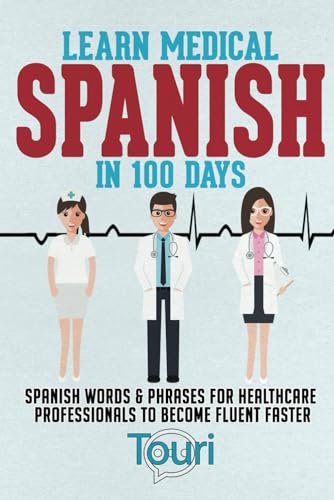
Learn Medical Spanish in 100 Days
Use this as the print companion for repeated medical Spanish practice. Read the phrase set first, then practice the same phrases aloud until they are easy to recall.
How to study this on a commute
The upcoming Touri Medical Spanish commute audio course should turn this article into daily listening practice: short phrases, patient scenarios, pronunciation loops, and quick recall drills that fit before or after a shift.
- Listen once for meaning. Do not pause yet. Get the situation first.
- Listen again and repeat aloud. Match the rhythm more than the accent.
- Cover the English. Try to produce the Spanish from the situation alone.
- Use one phrase at work or in roleplay. Real recall grows from use, not passive listening.
- Review the same phrase set tomorrow. Medical Spanish needs quick recall, so spaced repetition matters.
What healthcare workers usually need first
Most beginners do not need advanced grammar first. They need reliable phrases for greeting, identity checks, pain, symptoms, medication, allergies, body parts, follow-up, and reassurance. Grammar still matters, but it should serve communication. A patient-facing phrase that you can say correctly today is more useful than a grammar rule you cannot use under pressure.
That is also why role-based practice works. A nurse, medical assistant, physician, EMT, dental assistant, and front desk coordinator repeat different sentences. The more closely the practice matches the role, the easier it is to remember.
Respectful wording matters
Use formal language with adult patients unless a workplace standard or relationship makes informal speech appropriate. In most clinical settings, usted is the safer default because it sounds respectful and clear. Avoid joking translations, slang, or casual shortcuts when the patient is worried, in pain, or trying to explain symptoms.
If you do not understand the response, do not pretend. Use a clarification phrase, repeat what you believe you heard, or get interpreter support. Guessing is the fastest way for a helpful phrase to become a risk.
A 20-minute practice block
| Minute | Action | Goal |
|---|---|---|
| 0-3 | Read the phrase table once. | Understand the situation. |
| 3-8 | Say each phrase aloud three times. | Build pronunciation and comfort. |
| 8-13 | Cover the Spanish and recall from English. | Build active memory. |
| 13-17 | Roleplay two short patient exchanges. | Practice sequence, not isolated words. |
| 17-20 | Mark phrases that felt slow. | Choose tomorrow's review list. |
Common mistakes to avoid
- Memorizing long translated paragraphs instead of short, reusable phrases.
- Skipping pronunciation practice and only reading silently.
- Using basic phrase knowledge for sensitive conversations that require an interpreter.
- Improvising medication instructions instead of repeating the label or involving the pharmacist.
- Learning vocabulary without practicing the questions that make the words useful.
- Trying to sound fluent before building a reliable core phrase bank.
How this connects to Touri books and audio
Learn Medical Spanish in 100 Days can act as the written practice layer: phrase lists, daily repetition, and a visible path through the topic. The upcoming commute audio product should become the listening and speaking layer: hear the phrase, repeat it, recall it, then use it in a realistic mini-dialogue.
That connected practice path matters for real learners. A phrase table is more useful when it connects to a study plan, a role-specific page, a book chapter, and audio practice that helps the learner hear and recall the words.
FAQ
Can I use these phrases instead of a medical interpreter?
No. These phrases are for practice and routine support. Use a qualified medical interpreter whenever accuracy, consent, diagnosis, treatment, medication risk, discharge instructions, or patient safety is involved.
How long should I practice medical Spanish each day?
Ten to twenty minutes is enough if the session includes speaking aloud and review. A short daily loop is more useful than one long silent study session.
Is audio practice important for medical Spanish?
Yes. Healthcare communication is spoken in real time, so pronunciation, listening, and recall need practice. Written phrase lists help, but audio repetition makes the phrases easier to use under pressure.