


Medical Spanish
Medical Spanish for Healthcare Professionals: What to Learn First
If you work with Spanish-speaking patients, start with the phrases that support greeting, comfort, symptom questions, pain checks, medications, and basic next steps. This guide focuses on what healthcare professionals should learn first, how to practice safely, and where interpreter boundaries still apply.

What this page helps you decide
- If you are just starting, begin with greeting, pain, symptoms, medication, and follow-up phrases before specialized vocabulary.
- If you work in intake, nursing, urgent care, or front desk roles, build a small phrase bank around your real weekly tasks.
- If a conversation affects safety, consent, diagnosis, treatment, discharge, or legal documentation, use a qualified interpreter.
- If you want a structured next step, move from this overview to the Medical Spanish hub or a role-specific Touri guide.
Why this topic matters for Touri learners
The current Touri medical Spanish cluster already covers intake, symptoms, medication, pronunciation, interpreter use, and role-based phrase pages. This overview page now acts as the front door to that cluster. It is designed for healthcare professionals who are choosing what to study first, not for people looking for certification claims or a replacement for formal language support.
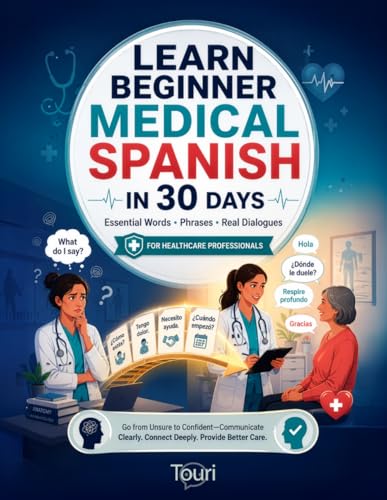
Learn Beginner Medical Spanish in 30 Days
Use this as the print companion for repeated medical Spanish practice. Start with your highest-frequency phrases, then review them aloud until recall is faster and calmer.
What healthcare professionals should learn first
Start with phrases that reduce confusion in routine patient-facing moments. The first goal is not sounding advanced. The first goal is being clear, respectful, and consistent under pressure. For most learners, that means working through five buckets in this order:
- Greeting and orientation: who you are, what is happening next, and how to get language support.
- Symptoms and pain: where it hurts, when it started, how strong it feels, and whether it is getting worse.
- Medication and allergies: what the patient takes, how often, and whether there are allergies.
- Simple instructions: sit here, please wait, breathe deeply, raise your arm, or follow me.
- Follow-up and safety: repeat-back, next steps, and interpreter escalation when the conversation becomes higher risk.
Starter phrase bank
| English | Spanish | Use case |
|---|---|---|
| Hello, my name is… | Hola, me llamo… | Greeting and introduction. |
| I am part of your care team. | Soy parte de su equipo de atencion. | Orienting the patient. |
| Where is the pain? | Donde le duele? | Pain location check. |
| When did it start? | Cuando empezo? | Symptom timing. |
| Do you have allergies? | Tiene alergias? | Medication and intake safety. |
| What medications do you take? | Que medicamentos toma? | Medication review. |
| Please breathe deeply. | Respire profundo, por favor. | Exam instruction. |
| Please wait here. | Espere aqui, por favor. | Routine direction. |
| I do not want to guess. | No quiero adivinar. | Signals a safety boundary. |
| We will call an interpreter. | Vamos a llamar a un interprete. | Escalation to qualified language support. |
Role-based priorities
Choose the row closest to the task you repeat most often. Study that small workflow first, then add one adjacent skill instead of trying to memorize the entire cluster at once.
| Role | Study first | Best next Touri page |
|---|---|---|
| Front desk | Greeting, scheduling, identity checks, forms, and interpreter requests | Medical Spanish for Front Desk and Scheduling |
| Nurse or MA | Vitals, pain, symptoms, medication, follow-up, calming phrasing | Medical Spanish for Nurses |
| Urgent care or EMT | Chief complaint, pain scale, urgency, transport, clear short commands | Spanish for EMTs and Urgent Care Teams |
| General clinic staff | Intake questions, symptoms, medication, discharge boundaries | Spanish Intake Questions for Clinics and Hospitals |
| Pharmacy-facing staff | Identity checks, pickup and refill workflow, clarification, interpreter escalation | Spanish for Pharmacy and Prescription Pickups |
How to practice safely
Medical Spanish should be practiced in short role-based loops, not as random vocabulary memorization. Picture one encounter you repeat often. It might be check-in, a pain question, a medication question, or a discharge reminder. Build five to ten phrases around that task and repeat them until they feel easy to retrieve. Then expand slowly.
| Minute | Action | Purpose |
|---|---|---|
| 0-4 | Read a short phrase set once for meaning. | Understand the situation, not just the words. |
| 4-10 | Repeat the phrases aloud three times each. | Build spoken recall and rhythm. |
| 10-15 | Roleplay the exchange from memory. | Turn isolated phrases into sequence. |
| 15-18 | Mark the lines that still feel slow. | Choose tomorrow’s review target. |
| 18-20 | Review interpreter-boundary phrases. | Keep safety language automatic too. |
When interpreter support is still required
This is the boundary that matters most. Use a qualified interpreter when the conversation involves diagnosis, informed consent, treatment decisions, medication risk, serious symptoms, discharge instructions, mental health risk, legal forms, or anything else where incomplete understanding could change care. A useful phrase bank can improve rapport and workflow, but it should never be stretched beyond safe use.
Common mistakes to avoid
- Memorizing long translated paragraphs instead of short reusable lines.
- Using basic Spanish beyond your comprehension level because the situation feels rushed.
- Skipping pronunciation and listening practice while only reading silently.
- Studying advanced anatomy terms before mastering frequent patient questions.
- Assuming medical Spanish study equals certification or interpreter competence.
Where to go next in the Touri medical Spanish cluster
Use this page as the overview, then move into the page that matches your immediate need. Follow one path for a week and practice its examples aloud; do not treat the links as authority to use Spanish beyond your verified language level or workplace policy.
- Medical Spanish for Healthcare Workers for the main hub.
- Learn Beginner Medical Spanish in 30 Days: A Study Plan for a daily routine.
- Medical Spanish for Front Desk and Scheduling for non-clinical check-in and appointment workflows.
- Spanish Intake Questions for Clinics and Hospitals for a basic intake sequence.
- Spanish Questions for Symptoms and Chief Complaint for high-frequency intake practice.
- Spanish Pain Scale Questions for focused pain wording practice.
- Spanish Phrases for Medication Instructions for vocabulary practice with strict counseling boundaries.
- Spanish for Pharmacy and Prescription Pickups for pickup and refill workflow language.
FAQ
What medical Spanish should healthcare professionals learn first?
Start with greeting, symptom questions, pain checks, medication and allergy questions, simple instructions, and interpreter-boundary phrases. Those are the lines many clinicians and staff repeat most often.
Can learning medical Spanish replace a medical interpreter?
No. Medical Spanish study can support routine communication and learning, but it does not replace qualified interpreter support for consent, diagnosis, treatment, discharge, or high-risk conversations.
Does learning medical Spanish make me certified?
No. Studying phrases, vocabulary, or pronunciation does not by itself create certification, legal authority, or professional interpreter competence.