


Medical Spanish
Medical Spanish for Front Desk and Scheduling
Medical Spanish for Front Desk and Scheduling should help front desk teams decide what to say during routine check-in, when to slow down, and when to hand the conversation to qualified language support or clinical staff. This guide focuses on arrival, forms, insurance, appointment times, callbacks, and safe handoffs, then connects the practice to a book or audio routine so the phrases are easier to remember.

Who this guide is for
This guide is for healthcare workers, students, clinic staff, and language learners who want medical Spanish for Front Desk and Scheduling to feel usable in real patient-facing moments. It is written for practical study, not for replacing professional interpreters or clinical judgment.
The goal is to help you build a reliable working phrase bank around appointment Spanish, scheduling Spanish medical, and clinic front desk Spanish. The best phrases are short, respectful, and easy to recall under pressure. That is why this page favors plain wording, formal usted tone, and repeatable study blocks over long grammar explanations.
Core phrases to practice first
For this topic, focus on check-in, forms, insurance, appointment scheduling, and basic patient history. Do not try to memorize every possible sentence. Start with the five to ten lines you can picture yourself saying during a normal workday, then add more after those are automatic.
Read the accent marks as part of each phrase. They show stress and distinguish words, so keep them in flashcards, handouts, and typed practice instead of treating them as optional decoration.
| English | Spanish | When to use it |
|---|---|---|
| What is your date of birth? | ¿Cuál es su fecha de nacimiento? | Patient identity check. |
| What is the reason for your visit? | ¿Cuál es la razón de su visita? | Simple routing before clinical questions. |
| Do you have insurance? | ¿Tiene seguro médico? | Front desk or billing workflow. |
| Please fill out this form. | Por favor llene este formulario. | Check-in paperwork. |
| Your appointment is at nine thirty. | Su cita es a las nueve y media. | Scheduling confirmation. |
| Please wait here. | Por favor, espere aquí. | Waiting room direction. |
Front desk phrase set by situation
Front desk Spanish works best in short sequences. Practice one situation at a time so the words come out in the order you actually need them.
| Situation | Useful phrase | Safe boundary |
|---|---|---|
| Arrival | Buenos días. ¿Tiene una cita hoy? | Confirm the visit, then switch to the interpreter process if the patient cannot follow the check-in steps. |
| Forms | Necesitamos este formulario, por favor. | Do not explain legal, consent, or privacy documents from memory. |
| Insurance | Necesito su tarjeta de seguro. | Escalate billing disputes or coverage questions that require detailed explanation. |
| Scheduling | Tenemos una cita disponible el martes. | Keep it to date and time unless medical urgency is being discussed. |
| Callback | Le vamos a llamar con mas informacion. | Use interpreter support when instructions, results, or next steps affect care. |
What front desk teams should learn before clinical phrases
The highest-value learner decision on this page is what to practice first. For front desk and scheduling roles, the answer is not advanced symptom vocabulary. Start with the exact administrative sequence you repeat every day, then add clinical-adjacent phrases only when your workplace role actually requires them.
| First skill | Practice phrase | Why it matters |
|---|---|---|
| Language preference | ¿Qué idioma prefiere para su atención médica? | It helps the team choose the right language support before care details begin. |
| Interpreter offer | ¿Quiere un intérprete? | It keeps patient understanding ahead of speed or convenience. |
| Appointment confirmation | Su cita es el jueves a las dos. | It prevents avoidable scheduling confusion. |
| Paperwork direction | Necesitamos que complete este formulario. | It supports routine intake without explaining legal or clinical content from memory. |
| Safe handoff | Voy a pedir ayuda para esta conversacion. | It gives staff a calm phrase to use when the conversation is beyond basic front-desk Spanish. |
That order also protects the learner. A receptionist who can clearly offer an interpreter, confirm a time, request a form, and hand off complex questions is more useful than a beginner trying to translate a long clinical explanation.
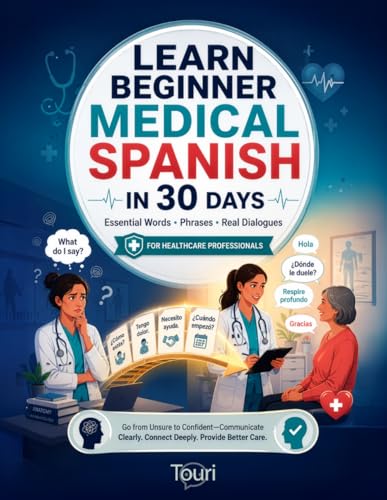
Learn Beginner Medical Spanish in 30 Days
Use this as the print companion for repeated medical Spanish practice. Read the phrase set first, then practice the same phrases aloud until they are easy to recall.
How to study this on a commute
The upcoming Touri Medical Spanish commute audio course should turn this article into daily listening practice: short phrases, patient scenarios, pronunciation loops, and quick recall drills that fit before or after a shift.
- Listen once for meaning. Do not pause yet. Get the situation first.
- Listen again and repeat aloud. Match the rhythm more than the accent.
- Cover the English. Try to produce the Spanish from the situation alone.
- Use one phrase at work or in roleplay. Real recall grows from use, not passive listening.
- Review the same phrase set tomorrow. Medical Spanish needs quick recall, so spaced repetition matters.
What healthcare workers usually need first
Most beginners do not need advanced grammar first. They need reliable phrases for greeting, identity checks, pain, symptoms, medication, allergies, body parts, follow-up, and reassurance. Grammar still matters, but it should serve communication. A patient-facing phrase that you can say correctly today is more useful than a grammar rule you cannot use under pressure.
That is also why role-based practice works. A nurse, medical assistant, physician, EMT, dental assistant, and front desk coordinator repeat different sentences. The more closely the practice matches the role, the easier it is to remember.
For a front desk learner, the best next step is sequence practice: greet the patient, confirm identity, ask for forms or insurance, repeat the appointment time, and then stop before clinical interpretation. Pair this page with Spanish intake questions when you need intake wording, symptom and chief complaint questions when you are studying routing language, and the medical Spanish starting guide to choose the next study lane.
Respectful wording matters
Use formal language with adult patients unless a workplace standard or relationship makes informal speech appropriate. In most clinical settings, usted is the safer default because it sounds respectful and clear. Avoid joking translations, slang, or casual shortcuts when the patient is worried, in pain, or trying to explain symptoms.
If you do not understand the response, do not pretend. Use a clarification phrase, repeat what you believe you heard, or get interpreter support. Guessing is the fastest way for a helpful phrase to become a risk.
A 20-minute practice block
| Minute | Action | Goal |
|---|---|---|
| 0-3 | Read the phrase table once. | Understand the situation. |
| 3-8 | Say each phrase aloud three times. | Build pronunciation and comfort. |
| 8-13 | Cover the Spanish and recall from English. | Build active memory. |
| 13-17 | Roleplay two short patient exchanges. | Practice sequence, not isolated words. |
| 17-20 | Mark phrases that felt slow. | Choose tomorrow's review list. |
Common mistakes to avoid
- Memorizing long translated paragraphs instead of short, reusable phrases.
- Skipping pronunciation practice and only reading silently.
- Using basic phrase knowledge for sensitive conversations that require an interpreter.
- Learning vocabulary without practicing the questions that make the words useful.
- Trying to sound fluent before building a reliable core phrase bank.
What not to handle at the front desk
A front desk phrase bank should make routine service smoother, not pull non-clinical staff into clinical interpretation. These moments need the process your clinic or hospital already uses for qualified language support, clinical staff, or both.
- The patient is describing chest pain, breathing trouble, pregnancy symptoms, mental health risk, severe pain, or safety concerns.
- The conversation involves medication dosing, side effects, allergies, test results, discharge warnings, or procedure risks.
- The patient is signing consent, refusing care, asking about rights, or making a decision that could affect treatment.
- You are tempted to summarize a complex answer because translating every detail feels too hard.
For language practice around higher-risk topics, use Touri phrase pages as study support only. Start with Spanish medication instruction phrases for vocabulary review, but use qualified interpreter support for real medication counseling or patient-specific instructions.
How this connects to Touri books and audio
Learn Beginner Medical Spanish in 30 Days can act as the written practice layer: phrase lists, daily repetition, and a visible path through the topic. The upcoming commute audio product should become the listening and speaking layer: hear the phrase, repeat it, recall it, then use it in a realistic mini-dialogue.
That connected practice path matters for real learners. A phrase table is more useful when it connects to a study plan, a role-specific page, a book chapter, and audio practice that helps the learner hear and recall the words.
Choose the next Touri practice path
Use this page as the front-desk starting point, then choose the next resource by job task instead of trying to study every medical Spanish topic at once.
| If your job task is… | Use this next | Practice goal |
|---|---|---|
| Opening the visit | Spanish intake questions | Move from check-in to a basic intake sequence. |
| Routing symptoms | Symptoms and chief complaint questions | Ask short routing questions and know when to hand off. |
| Studying daily | Learn Beginner Medical Spanish in 30 Days | Turn the phrases into a repeatable daily routine. |
| Building a wider phrase bank | Learn Medical Spanish in 100 Days | Expand into body systems, symptoms, medications, and follow-up practice. |
Source and prioritization note
This refresh was prioritized from Touri Search Console history. The local export covering March 30 through June 28, 2026 showed this page with 99 impressions, 5 clicks, and an average position of about 7.36. That made it the strongest medical Spanish blog page in the current export, worth improving with clearer front-desk decisions, safer interpreter boundaries, internal links, and book click paths.
FAQ
Can I use these phrases instead of a medical interpreter?
No. These phrases are for practice and routine support. Use a qualified medical interpreter whenever accuracy, consent, diagnosis, treatment, medication risk, discharge instructions, or patient safety is involved.
How long should I practice medical Spanish each day?
Ten to twenty minutes is enough if the session includes speaking aloud and review. A short daily loop is more useful than one long silent study session.
Is audio practice important for medical Spanish?
Yes. Healthcare communication is spoken in real time, so pronunciation, listening, and recall need practice. Written phrase lists help, but audio repetition makes the phrases easier to use under pressure.