

Conversational Spanish
Spanish Phrases for Travel: 100 Practical Phrases to Practice Before a Trip
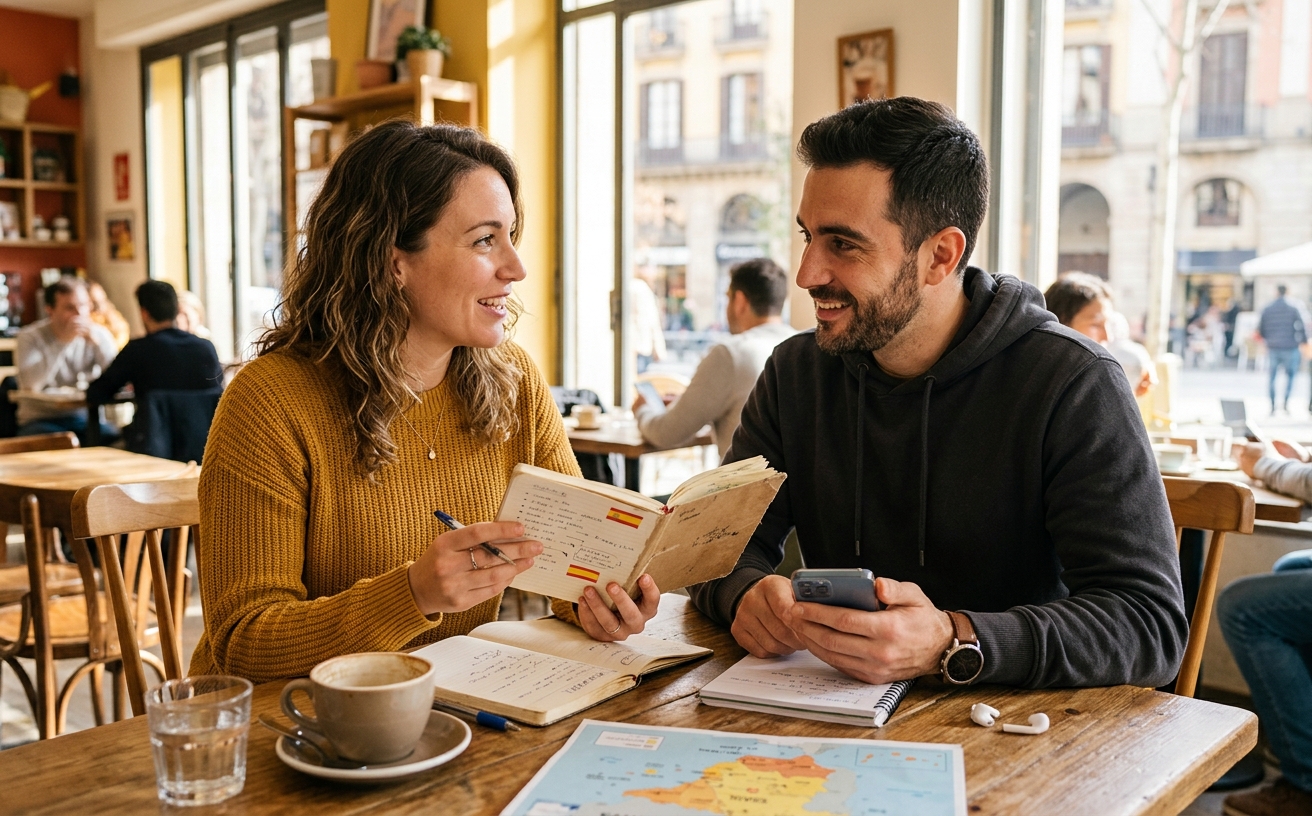
Start with the Spanish phrases that solve your next likely travel problem: greeting someone, finding a place, ordering food, paying, using transport, or asking for help. You do not need to memorize all 100 at once. Pick one situation, practice 10 phrases aloud, and keep the list available as a backup.
Choose your first 10 phrases
| Your next decision | Start with | Then practice |
|---|---|---|
| First day in a new city | Greetings and directions | Transport |
| Restaurants are your main concern | Food and drink | Payment and dietary needs |
| You will use trains or buses | Transport | Time and directions |
| You want a compact safety set | Help and emergencies | Identification and location details |
100 Days of Real World Spanish
Want a broader daily vocabulary routine after this travel phrase set? Use the book for short, repeatable practice across real-world topics.
Greetings and courtesy: phrases 1–15
| # | Spanish | English |
|---|---|---|
| 1 | Hola. | Hello. |
| 2 | Buenos días. | Good morning. |
| 3 | Buenas tardes. | Good afternoon. |
| 4 | Buenas noches. | Good evening / good night. |
| 5 | Por favor. | Please. |
| 6 | Gracias. | Thank you. |
| 7 | Muchas gracias. | Thank you very much. |
| 8 | De nada. | You’re welcome. |
| 9 | Disculpe. | Excuse me. |
| 10 | Lo siento. | I’m sorry. |
| 11 | ¿Habla inglés? | Do you speak English? |
| 12 | Hablo un poco de español. | I speak a little Spanish. |
| 13 | No entiendo. | I don’t understand. |
| 14 | ¿Puede repetirlo, por favor? | Can you repeat that, please? |
| 15 | ¿Puede hablar más despacio? | Can you speak more slowly? |
Directions and places: phrases 16–30
| # | Spanish | English |
|---|---|---|
| 16 | ¿Dónde está…? | Where is…? |
| 17 | ¿Dónde está el baño? | Where is the bathroom? |
| 18 | ¿Cómo llego al centro? | How do I get downtown? |
| 19 | ¿Está lejos? | Is it far? |
| 20 | ¿Está cerca? | Is it nearby? |
| 21 | ¿Puedo ir caminando? | Can I walk there? |
| 22 | ¿Me lo puede mostrar en el mapa? | Can you show me on the map? |
| 23 | A la derecha. | To the right. |
| 24 | A la izquierda. | To the left. |
| 25 | Todo recto. | Straight ahead. |
| 26 | En la esquina. | On the corner. |
| 27 | Al lado de… | Next to… |
| 28 | Enfrente de… | Across from… |
| 29 | Estoy perdido / perdida. | I’m lost. |
| 30 | Busco esta dirección. | I’m looking for this address. |
Transport and time: phrases 31–45
| # | Spanish | English |
|---|---|---|
| 31 | ¿Dónde está la estación? | Where is the station? |
| 32 | ¿Dónde está la parada de autobús? | Where is the bus stop? |
| 33 | Un billete a…, por favor. | One ticket to…, please. |
| 34 | ¿Cuánto cuesta el billete? | How much is the ticket? |
| 35 | ¿A qué hora sale? | What time does it leave? |
| 36 | ¿A qué hora llega? | What time does it arrive? |
| 37 | ¿Este autobús va a…? | Does this bus go to…? |
| 38 | ¿Tengo que hacer transbordo? | Do I need to transfer? |
| 39 | ¿Cuál es el andén? | Which platform is it? |
| 40 | ¿Hay retraso? | Is there a delay? |
| 41 | Necesito un taxi. | I need a taxi. |
| 42 | Lléveme a esta dirección, por favor. | Take me to this address, please. |
| 43 | ¿Cuánto tarda? | How long does it take? |
| 44 | ¿Cuánto cuesta aproximadamente? | About how much does it cost? |
| 45 | Puede parar aquí. | You can stop here. |
Hotels and accommodation: phrases 46–57
| # | Spanish | English |
|---|---|---|
| 46 | Tengo una reserva. | I have a reservation. |
| 47 | La reserva está a nombre de… | The reservation is under the name… |
| 48 | ¿A qué hora es la entrada? | What time is check-in? |
| 49 | ¿A qué hora es la salida? | What time is check-out? |
| 50 | ¿Está incluido el desayuno? | Is breakfast included? |
| 51 | ¿Cuál es la contraseña del wifi? | What is the Wi-Fi password? |
| 52 | ¿Puede guardar mi equipaje? | Can you store my luggage? |
| 53 | La llave no funciona. | The key doesn’t work. |
| 54 | No hay agua caliente. | There is no hot water. |
| 55 | La habitación está muy ruidosa. | The room is very noisy. |
| 56 | ¿Tiene otra habitación disponible? | Do you have another room available? |
| 57 | Necesito una toalla, por favor. | I need a towel, please. |
Food and restaurants: phrases 58–75
| # | Spanish | English |
|---|---|---|
| 58 | Una mesa para dos, por favor. | A table for two, please. |
| 59 | ¿Tiene una mesa afuera? | Do you have a table outside? |
| 60 | ¿Me trae el menú, por favor? | Can you bring me the menu, please? |
| 61 | ¿Qué recomienda? | What do you recommend? |
| 62 | Quisiera…, por favor. | I would like…, please. |
| 63 | Para mí… | For me… |
| 64 | Agua sin gas, por favor. | Still water, please. |
| 65 | Agua con gas, por favor. | Sparkling water, please. |
| 66 | Sin hielo, por favor. | No ice, please. |
| 67 | Sin picante, por favor. | Not spicy, please. |
| 68 | Soy vegetariano / vegetariana. | I’m vegetarian. |
| 69 | Soy alérgico / alérgica a… | I’m allergic to… |
| 70 | ¿Lleva frutos secos? | Does it contain nuts? |
| 71 | ¿Lleva lácteos? | Does it contain dairy? |
| 72 | ¿Puede prepararlo sin…? | Can you prepare it without…? |
| 73 | Está delicioso. | It’s delicious. |
| 74 | La cuenta, por favor. | The check, please. |
| 75 | ¿Está incluido el servicio? | Is service included? |
Shopping and payment: phrases 76–87
| # | Spanish | English |
|---|---|---|
| 76 | ¿Cuánto cuesta? | How much does it cost? |
| 77 | Es demasiado caro. | It’s too expensive. |
| 78 | Solo estoy mirando. | I’m just looking. |
| 79 | ¿Tiene una talla más grande? | Do you have a larger size? |
| 80 | ¿Tiene una talla más pequeña? | Do you have a smaller size? |
| 81 | ¿Puedo probármelo? | Can I try it on? |
| 82 | Me lo llevo. | I’ll take it. |
| 83 | ¿Aceptan tarjetas? | Do you accept cards? |
| 84 | Quiero pagar en efectivo. | I want to pay in cash. |
| 85 | ¿Me da un recibo? | Can I have a receipt? |
| 86 | ¿Dónde hay un cajero automático? | Where is an ATM? |
| 87 | Creo que hay un error en la cuenta. | I think there is an error on the bill. |
Help and emergencies: phrases 88–100
| # | Spanish | English |
|---|---|---|
| 88 | Necesito ayuda. | I need help. |
| 89 | Es una emergencia. | It’s an emergency. |
| 90 | Llame a la policía. | Call the police. |
| 91 | Llame a una ambulancia. | Call an ambulance. |
| 92 | Necesito un médico. | I need a doctor. |
| 93 | ¿Dónde está la farmacia? | Where is the pharmacy? |
| 94 | He perdido mi pasaporte. | I lost my passport. |
| 95 | Me han robado la cartera. | My wallet was stolen. |
| 96 | No encuentro a mi acompañante. | I can’t find my companion. |
| 97 | Mi teléfono no funciona. | My phone isn’t working. |
| 98 | ¿Puede escribirlo? | Can you write it down? |
| 99 | Esta es la dirección de mi hotel. | This is my hotel’s address. |
| 100 | ¿Cuál es el número de emergencias? | What is the emergency number? |
How to practice without memorizing a giant list
- Choose one situation. Start with the section you are most likely to use during the first 24 hours of your trip.
- Mark 10 phrases. Say each one slowly, then say it again while looking away from the page.
- Practice the reply. A question only helps if you can recognize an answer such as a la derecha, el andén cinco, or a price and time.
- Personalize blanks. Replace the destination in Un billete a…, por favor and the name in your hotel reservation phrase.
- Keep a backup. Save the address of your accommodation and essential travel details offline. A phrase list supports communication; it does not replace official local guidance or emergency services.
Regional wording and pronunciation notes
Spanish varies by country. You may hear billete, boleto, or pasaje for a ticket, and autobús, bus, camión, or colectivo for local transport. The phrases above are broadly understandable, but local signs and replies may use a different word. Listen for the key noun, ask someone to repeat it, and confirm important details on a screen, ticket, or map.
If you want more speaking patterns, continue with conversational Spanish dialogues for beginners. For a daily reading-and-review routine, use the 20-minute Spanish reading practice guide. Browse Touri’s Spanish books and learning resources when you are ready to choose a longer practice path.
FAQ
What Spanish phrases should I learn first for travel?
Learn greetings, “I don’t understand,” “Can you speak more slowly?”, directions, payment, transport, and help phrases first. Then add the section tied to your itinerary.
How many travel phrases can a beginner learn before a trip?
Start with 10 phrases you are likely to use, not all 100. Add another small set after you can say the first group and recognize likely replies.
Will these phrases work in Spain and Latin America?
Most are broadly understandable, but vocabulary differs by region. Expect alternatives for words such as ticket, bus, computer, and cell phone, and confirm important details visually when possible.